Demand forecast vs. sales forecast: data and decisions
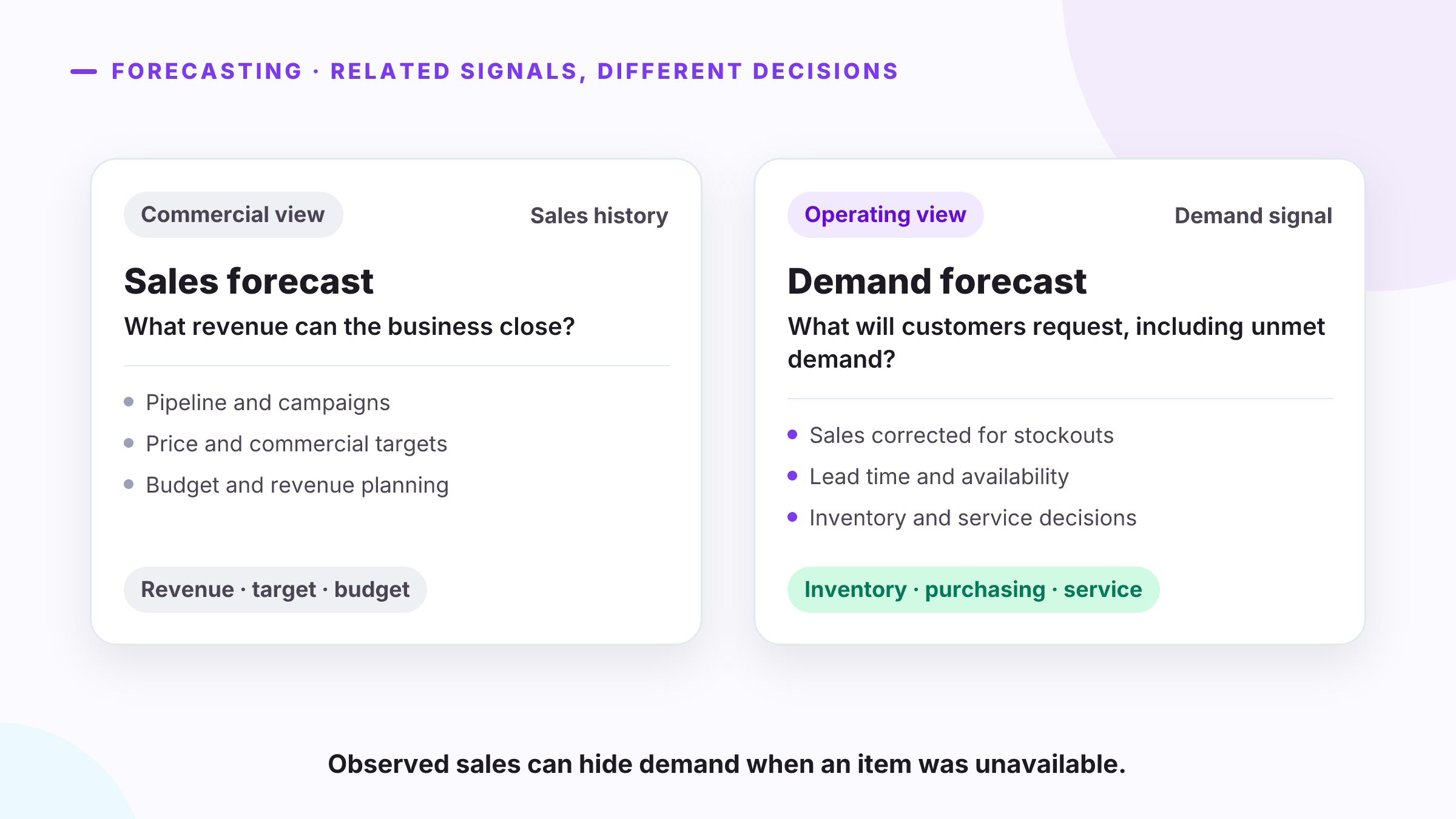
A sales forecast estimates what your business expects to sell; a demand forecast estimates what the market will request and turns that signal into operating decisions. Sometimes both names describe the same series. The problem starts when sales, purchasing and finance use one number to answer different questions.
The distinction matters because a recorded sale is not always the same as actual demand. When a SKU was out of stock, you can only observe what you managed to sell; research calls that observation a censored version of the underlying demand. Treating it as zero demand or as an ordinary week makes the next forecast start too low. Mersereau (2015) explains why sales history needs to be interpreted alongside inventory availability.
The difference in one table
There is no universal line: some ERPs even use sales forecast for a forecast that feeds demand planning. What matters is agreeing on the field, the granularity and the decision that go with each number.
| Question | Sales forecast | Demand forecast |
|---|---|---|
| What does it anticipate? | Expected sales by customer, channel, product line or period; it may be stated in units, revenue, or both. | Units customers are expected to request by SKU, location and period. |
| Who uses it first? | Sales, leadership and finance. | Planning, purchasing, inventory, production and S&OP. |
| What data does it need? | Commercial history, pipeline, prices, campaigns and sales-team knowledge. | Sales or order history, available inventory, stockouts, returns, lead time, and signals such as promotions or calendar events. |
| What decision does it enable? | Sales target, budget, sales capacity and pipeline follow-up. | Safety stock, reorder point, purchasing, production, distribution and service commitments. |
| What is the risk if used alone? | Mistaking a target or an optimistic scenario for the number that must be supplied. | Ignoring commercial signals that have not yet appeared in history. |
The difference is not between “a bad sales number” and “a good demand number.” A sound forecast starts with data and its intended use. Forecasting: Principles and Practice separates forecast, goal and plan: a forecast describes the future using available information; a goal states what you want to happen; and a plan defines the actions to close the gap.
Actual sales do not always reveal all demand
Imagine a SKU with real interest for 100 units in a week. If the warehouse only had 70 units, the system will see 70 sales. Without an out-of-stock signal, that 70 can enter the model as if it represented all demand for the week.
The next cycle can repeat the error: it forecasts 70, buys roughly 70, and loses sales again. This is not about inventing lost demand; it is about preserving the evidence you have and treating those periods carefully:
- flag when a SKU or location had no availability;
- separate cancelled, delayed and returned orders from ordinary sales;
- record promotions, price changes and events that explain a spike;
- review how granular the series needs to be: SKU, channel, location and week do not always tell the same story.
The detail level should follow the decision. A monthly product-family view can be enough for a leadership meeting; purchasing and replenishment need the forecast at SKU, location and lead-time horizon. That choice of product, outlet, frequency and horizon should be made before selecting a model, as Hyndman and Athanasopoulos recommend.
An example: a campaign should not erase the baseline forecast
Suppose your baseline forecast for a SKU is 100 units next month. Sales tells you that a promotion, if executed, could add 20 units. The common mistake is to replace 100 with 120 without retaining the reason.
A more useful approach keeps three fields:
| Field | Example | Why it matters |
|---|---|---|
| Baseline forecast | 100 units | The best estimate from history and its patterns. |
| Commercial assumption | Confirmed promotion | Makes clear which new fact changes the expectation. |
| Demand plan | 120 units | A number purchasing, inventory and operations can review against capacity and risk. |
That lets the team later measure whether the promotion created the expected uplift and whether the adjustment helped. Commercial judgment is not removed; it becomes auditable. Our article on Forecast Value Added explains how to compare the baseline, every adjustment and the actual outcome.
Which decisions should each forecast guide?
Use a sales forecast when the question is commercial: what revenue is reasonable, how far is the pipeline from target, and which campaign needs follow-up? Use a demand forecast when the question commits inventory, cash, capacity or service.
The chain should be explicit:
- Sales contributes pipeline, material accounts and confirmed promotions.
- Planning generates and measures a baseline forecast at the required granularity.
- Purchasing and inventory turn the demand plan into safety stock and reorder points.
- S&OP resolves gaps between commercial ambition, expected demand and available capacity in an agreed plan.
This flow matches planning systems in practice: a demand forecast feeds material and capacity requirements, while supply policies determine how to respond. Microsoft describes that step from demand and supply forecasts to planned orders.
How to start without creating two versions of the truth
You do not need two competing spreadsheets. You need one forecasting source with clear views and assumptions:
- define a shared hierarchy of product, customer, channel and location;
- retain the baseline forecast and log commercial adjustments separately;
- flag stockout periods or data that do not represent normal demand;
- measure error and bias at the same granularity where decisions are made; our guide to MAPE, WMAPE and bias can help;
- take meaningful exceptions to S&OP, rather than restarting a debate for every SKU.
Forecast Studio helps turn commercial history and external signals into a measurable demand forecast, so sales can contribute context without purchasing or inventory working from a target disguised as a forecast. To review the difference with your own data, book a free demo.
Sources: Hyndman & Athanasopoulos, Forecasting: Principles and Practice — forecasting, goals and planning · Hyndman & Athanasopoulos — determining what to forecast · Mersereau, Demand Estimation from Censored Observations with Inventory Record Inaccuracy · Microsoft, Inventory forecasts