S&OP in plain terms: getting sales and operations to agree on one number
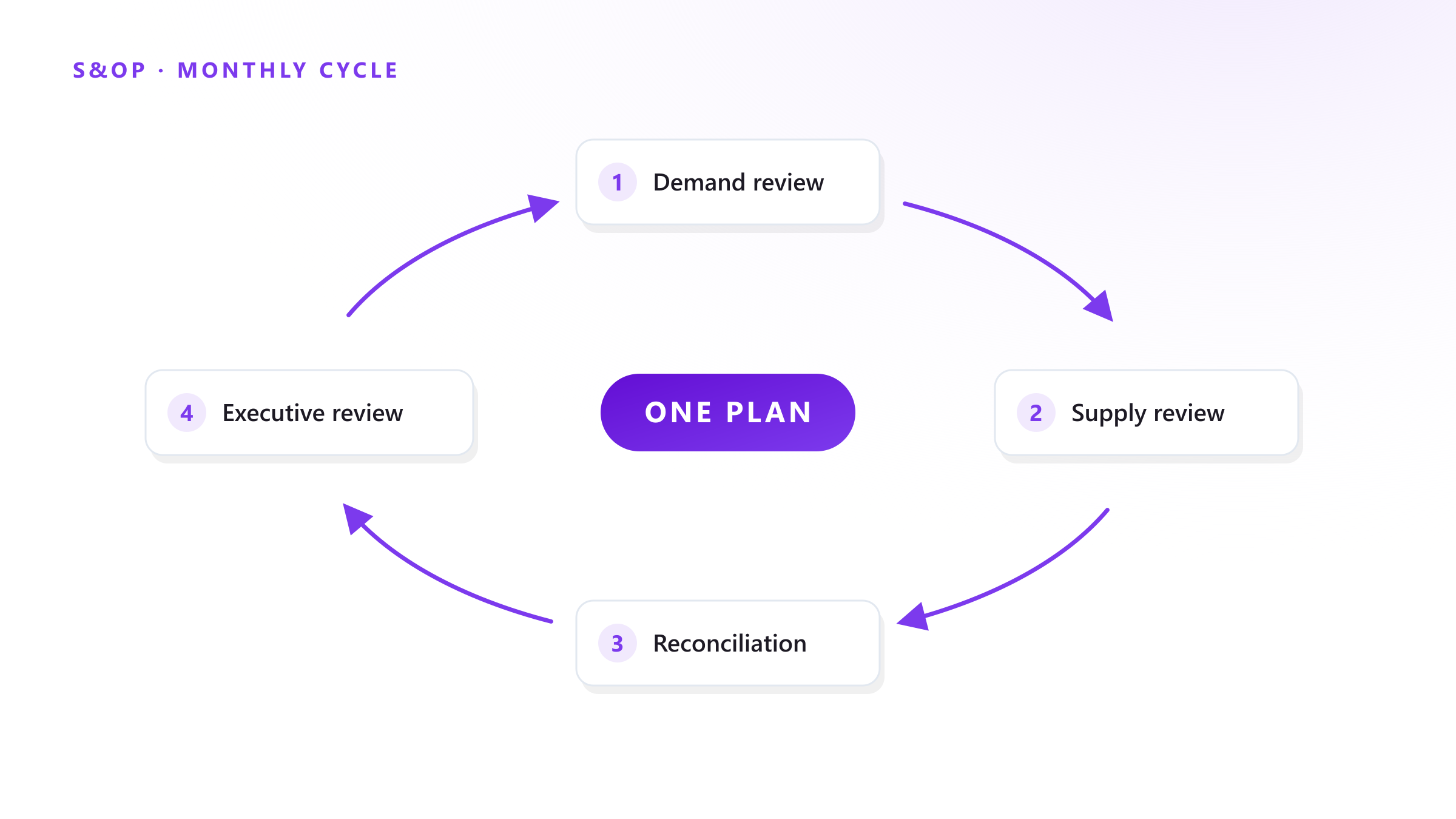
Sales and Operations Planning (S&OP) is the monthly rhythm that gets sales, operations and finance to commit to one view of demand — and then plan supply, inventory and budgets against it. It works by taking the most accurate forecast you can produce and making it the number the whole company acts on — alignment multiplies the value of a good forecast; it never substitutes for one.
The idea is older than the software that now runs it: it was developed in the 1980s by Dick Ling at the Oliver Wight organization and codified in Orchestrating Success (Ling & Goddard), the first book on the process. Four decades later it is still the backbone of planning at most large manufacturers — because the problem it attacks never went away.
The problem S&OP solves
In most companies, sales has its own number, operations has another, and finance has a third. Each lives in a separate spreadsheet. When they disagree — and they always do — the company silently over- or under-produces, and nobody owns the gap.
The worst version of this is when the “forecast” is really the budget in disguise: a top-down financial target pushed into the demand plan. Demand gets inflated to match the target, actual sales come in lower, and the difference piles up as inventory. S&OP replaces those parallel truths with a single, agreed plan — and makes the gaps visible instead of hiding them.
The monthly cycle
A healthy S&OP cycle moves through a few steps every month:
- Demand review — refresh the statistical forecast, layer in market and sales intelligence, and agree on the unconstrained demand plan.
- Supply review — test that plan against capacity, lead times and inventory.
- Reconciliation — surface the gaps where demand and supply (or the budget) do not line up, with options and trade-offs.
- Executive review — leadership signs off on one plan and the decisions it implies.
Each step has an owner and a deliverable, and the cycle repeats every month — that cadence, not the meetings themselves, is what builds the discipline.
What “one number” really means
A fair warning, because the phrase gets misused: Gartner calls literal one-number planning a myth, and they are right. Sales thinks in revenue, supply in units, finance in margin — collapsing all of that into a single figure erases information each function needs.
What S&OP actually delivers is one agreed plan, expressed in units and money, with its assumptions on the table. The demand plan does not get forced to equal the financial target; when they differ, the gap is stated, sized and assigned to someone. One plan, multiple views of it — that is the realistic version of “one number.”
Why it pays off
The payoff has been measured. McKinsey finds that companies running a mature, integrated planning process (S&OP and its broader sibling, IBP) outperform those that don’t by a wide margin:
- One to two percentage points more EBIT.
- Service levels 5 to 20 percentage points higher.
- Delivery penalties and missed sales 40–50% lower.
- Freight costs and capital intensity 10–15% lower.
- Planners 10–20% more productive.
The mechanism is simple: when everyone plans from the same number, you stop buffering against internal disagreement. Inventory drops, and supply gets built for actual expected demand instead of for the loudest voice in the room.
How to get started without boiling the ocean
Gartner’s maturity model describes five stages, and most companies sit in the first two or three — which is fine. You climb by iterating, not by launching a transformation program:
- Start with one product family and a strict monthly cadence; expand once the routine holds.
- Agree on the scoreboard first: forecast accuracy (WAPE or MAPE), service level, inventory. If you don’t measure the plan, the meeting drifts back to opinions.
- Feed it a credible baseline. The demand review needs a statistical forecast as its starting point — that is exactly what Forecast Studio automates nightly, so the debate starts from data instead of from a blank cell.
- Let the plan drive inventory policy: the agreed demand plan is what your safety stock calculations should hang off.
Conclusion
S&OP is not a meeting; it is an operating rhythm. A solid demand forecast is the input that makes the whole cycle credible — without it, the meetings become negotiations over opinions instead of decisions over data. Get the cadence going, measure the plan, and let the numbers earn the room’s trust month by month. S&OP is also step four of the wider cycle we map in our complete demand planning guide.
Want a demand baseline your S&OP can build on? Book a free demo and we’ll show you Forecast Studio in action in 30 minutes.
Sources: Ling & Goddard, Orchestrating Success · McKinsey, The transformative power of integrated business planning · Gartner, One-Number S&OP: Separating Myth From Truth · Gartner, five-stage S&OP maturity model