5 forecasting failures that cost millions
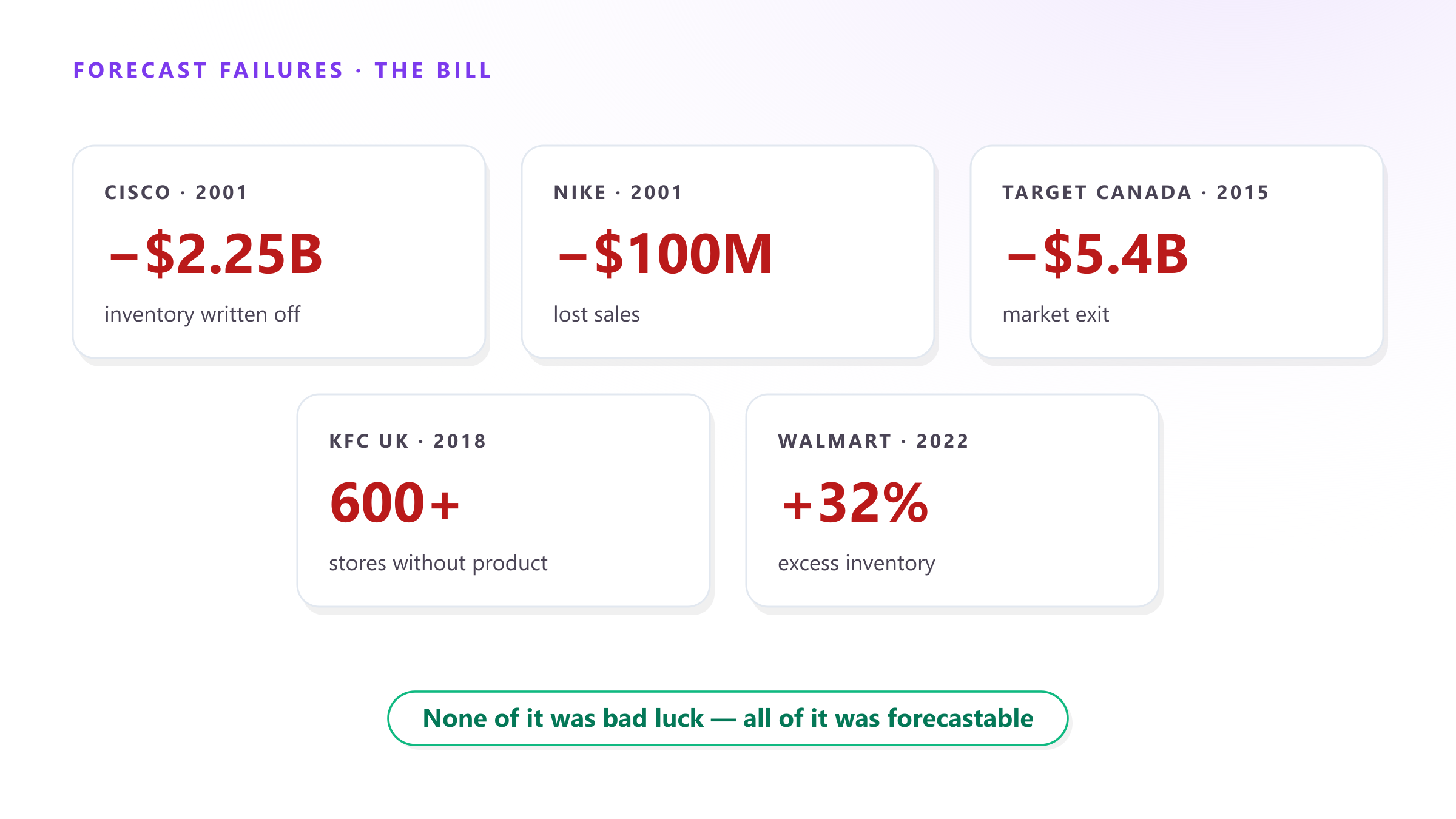
Forecasting mistakes feel abstract — until you put a price tag on them. The five cases below are documented, public and expensive. None of them was bad luck. In every single one there was a signal somebody ignored, a number nobody measured, or a plan built on hope instead of data.
1. Cisco, 2001 — a $2.25 billion write-off
At the peak of the dot-com boom, Cisco ordered components based on its own sales forecasts instead of actual demand, with no downside scenario. Its contract manufacturers built against the same inflated numbers — the classic bullwhip — and when demand vanished in 2001, Cisco wrote off $2.25 billion of inventory, much of it custom parts that could only be scrapped.
What would have prevented it: forecasts stress-tested against real orders, a downside scenario, and bias measured continuously — a forecast that is always optimistic is not a forecast, it is a target.
2. Nike, 2001 — $100 million in lost sales
Nike’s brand-new i2 demand-planning system ordered thousands of the wrong sneakers: too many of the model nobody wanted, too few Air Jordans. The cause wasn’t exotic — rushed implementation and bad input data scaled into bad orders across the supply chain. The bill: about $100 million in lost sales and a 20% stock drop.
What would have prevented it: clean history before go-live, and a parallel run measuring the new forecast against the old one before trusting it with purchase orders. Garbage in, garbage out — the same lesson as spreadsheets, at enterprise scale.
3. Target Canada, 2013–2015 — a $5.4 billion exit
Target opened 124 stores in Canada in under two years. Its item master data was riddled with errors — wrong dimensions, wrong costs, wrong barcodes — and its new forecasting system had no Canadian sales history to learn from, so the company let optimistic vendor estimates drive ordering. The result was surreal: distribution centers bursting while shelves sat empty. Target exited Canada with a US$5.4 billion writedown, closing all 133 stores.
What would have prevented it: data quality as a launch gate, and forecasts rebuilt from real sell-through from week one instead of vendor optimism.
4. KFC UK, 2018 — two-thirds of ~900 stores closed
KFC switched its UK distribution to a new operator running a single depot — and the first-day failure cascaded until only 266 of 870 stores were open. A chicken chain without chicken for days. Demand never moved; the supply plan behind it had a single point of failure and no contingency.
What would have prevented it: this one is a supply failure, not a demand miss — but the lesson is the same one S&OP exists to teach: a demand plan is only as good as the supply plan tested against it, scenario included.
5. Walmart, 2022 — a 32% inventory hangover
Coming out of the pandemic, Walmart (and most large retailers) extrapolated the goods-buying boom forward — and consumers rotated their spending to services and essentials instead. Inventory came in 32% above the prior year, and clearing it took quarters of margin-crushing markdowns across the industry.
What would have prevented it: models that react to the turn, not the trend — demand signals refreshed continuously, and the humility to cut the forecast when the data does.
The pattern: none of this was bad luck
Look at the five again. Inflated forecasts nobody challenged. Bad data nobody validated. No history, no scenarios, no measurement. These are process failures, and processes can be fixed:
- Measure the forecast — error and bias, every cycle.
- Build it from data, not from targets or vendor enthusiasm — a statistical baseline doesn’t fall in love with a number.
- Refresh it continuously, so the model catches the turn while there is still time to act.
That discipline is precisely what Forecast Studio automates: per-SKU forecasts retrained nightly on your real sales, with accuracy and bias measured so the optimistic override has nowhere to hide. If you’d rather build the discipline than star in the sequel, start with our complete demand planning guide.
Rather read about your own numbers than someone else’s disaster? Book a free demo — 30 minutes, your data.
Sources: Supply Chain Nuggets, Cisco’s $2.25B inventory collapse · CIO, Nike Rebounds · Canadian Business, The Last Days of Target Canada · About Resilience, The KFC logistics blunder · Talk Business, Retailers grapple with inventory glut