Demand planning: the complete guide (process, metrics, inventory and tools)
Demand planning is the discipline of answering one question rigorously: how much will we sell — by product, by location, by period — and what should we do about it? Get it right and inventory, purchasing, production and cash flow all get easier. Get it wrong and you pay the bill retail pays every year: around $1.77 trillion in inventory distortion — empty shelves on one side, frozen cash on the other.
This is the hub guide: the whole process end to end, with links to our deep dives on each piece. Bookmark it; everything else on this blog hangs off it.
What demand planning is (and isn’t)
Demand planning turns your sales history and external signals into an actionable forecast, and that forecast into decisions. It sits upstream of everything:
- It is not just forecasting. The forecast is the engine, but planning includes turning it into safety stock, reorder points, purchase orders and budgets.
- It is not supply planning. Demand planning estimates what the market will ask for; supply planning decides how to meet it. S&OP is the monthly meeting where the two agree on one plan.
- It is not a budget. A budget is what you want to happen; a forecast is what the data says will happen. Confusing the two is how optimistic numbers quietly pile up inventory.
New to the vocabulary? Keep our glossary of 30 terms open in another tab.
The process: five steps, repeated monthly
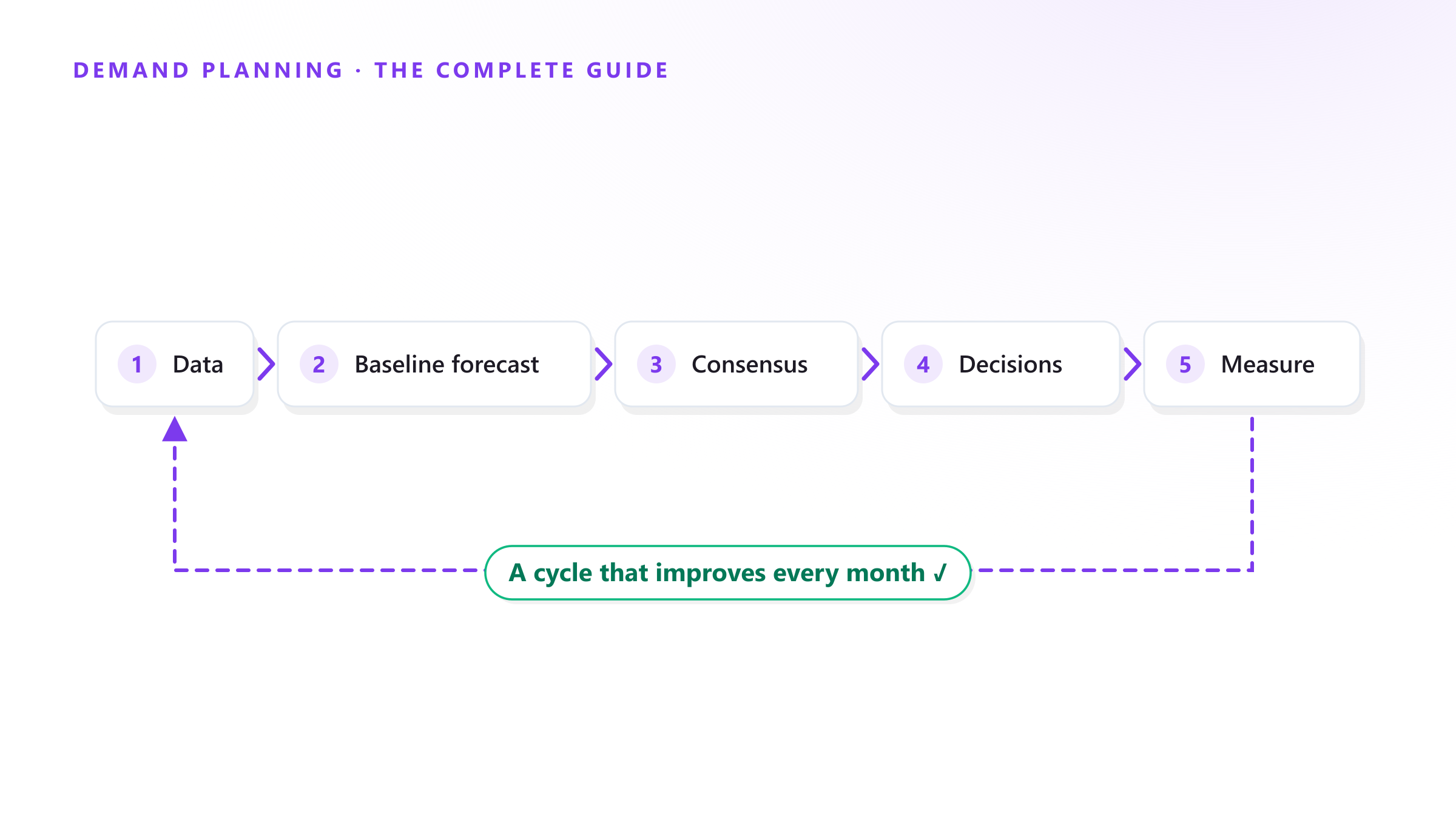
Mature teams run demand planning as a cycle, not a yearly event. Five steps:
1. Clean and assemble the data
Sales history per SKU and location, corrected for stockouts (a zero-sales week during a stockout is censored demand, not zero demand), plus the external drivers: prices, promotions calendar, weather, holidays and events. These exogenous variables are not decoration — they’re the signals that won the M5 competition, the largest public forecasting benchmark ever run.
2. Build the baseline forecast
A statistical or Machine Learning forecast, untouched by human hands — the reference everything else is measured against. The evidence on method choice is unambiguous: in M5, on 42,840 real Walmart series, all top-50 methods were Machine Learning and the winner beat the best classical benchmark by 22.4%. If you’re still on spreadsheets, we wrote both an honest Excel tutorial and the case for moving beyond it.
3. Enrich with market intelligence — carefully
Sales knows about the new client; marketing knows about next month’s campaign. Add that — but measure whether your touches help. The research is uncomfortable: Fildes et al. analyzed 60,000+ real adjustments and found small tweaks and optimistic upward overrides usually subtract accuracy. Forecast Value Added (FVA) is how you audit it.
4. Turn the forecast into decisions
This is where planning earns money:
- Inventory: size safety stock from demand variability and service level — better forecasts shrink the buffer you need.
- Purchasing: compute reorder points from forecast demand over lead time, per SKU and location.
- Attention: segment the catalog with ABC/XYZ so planner hours go where they pay.
- Alignment: feed the consensus number into S&OP so commercial, supply and finance run on one plan. McKinsey documents the payoff of integrated planning done well.
5. Measure, learn, repeat
Compare forecast vs. actuals every cycle with the metrics that actually matter: WMAPE (volume-weighted, so the long tail doesn’t lie to you) and bias (the silent inventory-builder). A forecast you don’t measure is an opinion with a spreadsheet.
What good looks like: benchmarks
- Accuracy gains from ML: McKinsey estimates AI-driven forecasting cuts errors 20–50%, lost sales from unavailability up to 65%, warehousing costs 5–10% and administrative costs 25–40%.
- The cost of skipping it: we documented five real failures — Cisco’s $2.25B write-off, Target Canada’s $5.4B exit — none of them bad luck, all of them forecastable.
- Sector difficulty varies: retail is the deep end — granularity, promotions, weather (why retail is hardest).
Common failure modes
- Forecasting at the wrong level — a country-level forecast can be 95% accurate while every store order is wrong.
- Ignoring the demand drivers — a model without promotion and price inputs will be surprised twice a year, on schedule.
- Unmeasured human overrides — well-intentioned touches that subtract accuracy, invisible without FVA.
- Plain MAPE worship — equal-weighting the long tail until the metric stops describing the money.
- Set-and-forget parameters — safety stocks and reorder points calculated once, in a demand regime that no longer exists.
Tooling: from spreadsheet to ML
The honest progression most companies follow:
| Stage | Tool | Breaks when… |
|---|---|---|
| Starting out | Excel (tutorial) | catalog grows past dozens of SKUs |
| Growing | ERP modules / basic stats | you need exogenous variables and daily refresh |
| Scaling | ML platforms (our comparison of 8 tools) | — |
When you evaluate vendors — us included — demand a trial on your own history, measured with WMAPE against your current method. Forecast Studio is built for exactly the middle of that market: SMBs and mid-market companies in Latin America that have outgrown Excel and don’t want to staff a data-science team. One ML engine, thousands of SKUs nightly, unlimited exogenous variables, inventory and purchasing decisions out of the box, up to 95% accuracy.
Start this quarter: a minimal checklist
- Pick your 100 highest-value SKUs (ABC makes it fast).
- Build a baseline forecast and freeze it before anyone adjusts it.
- Measure last quarter’s forecast (or your implicit one — the purchase orders) with WMAPE and bias.
- Recalculate safety stock and reorder points from the new forecast.
- Put one monthly demand review on the calendar — 90 minutes, one agreed plan.
Or compress the whole list into one step: book a free 30-minute demo and we’ll run your real history through Forecast Studio — no credit card, no slide deck, just your data forecasted properly.
Sources: IHL Group, inventory distortion study · Makridakis et al., M5 accuracy competition, IJF · Fildes et al., Effective forecasting and judgmental adjustments, IJF · McKinsey, AI-driven operations forecasting · McKinsey, The transformative power of integrated business planning