Demand planning glossary: 30 terms every planner should know
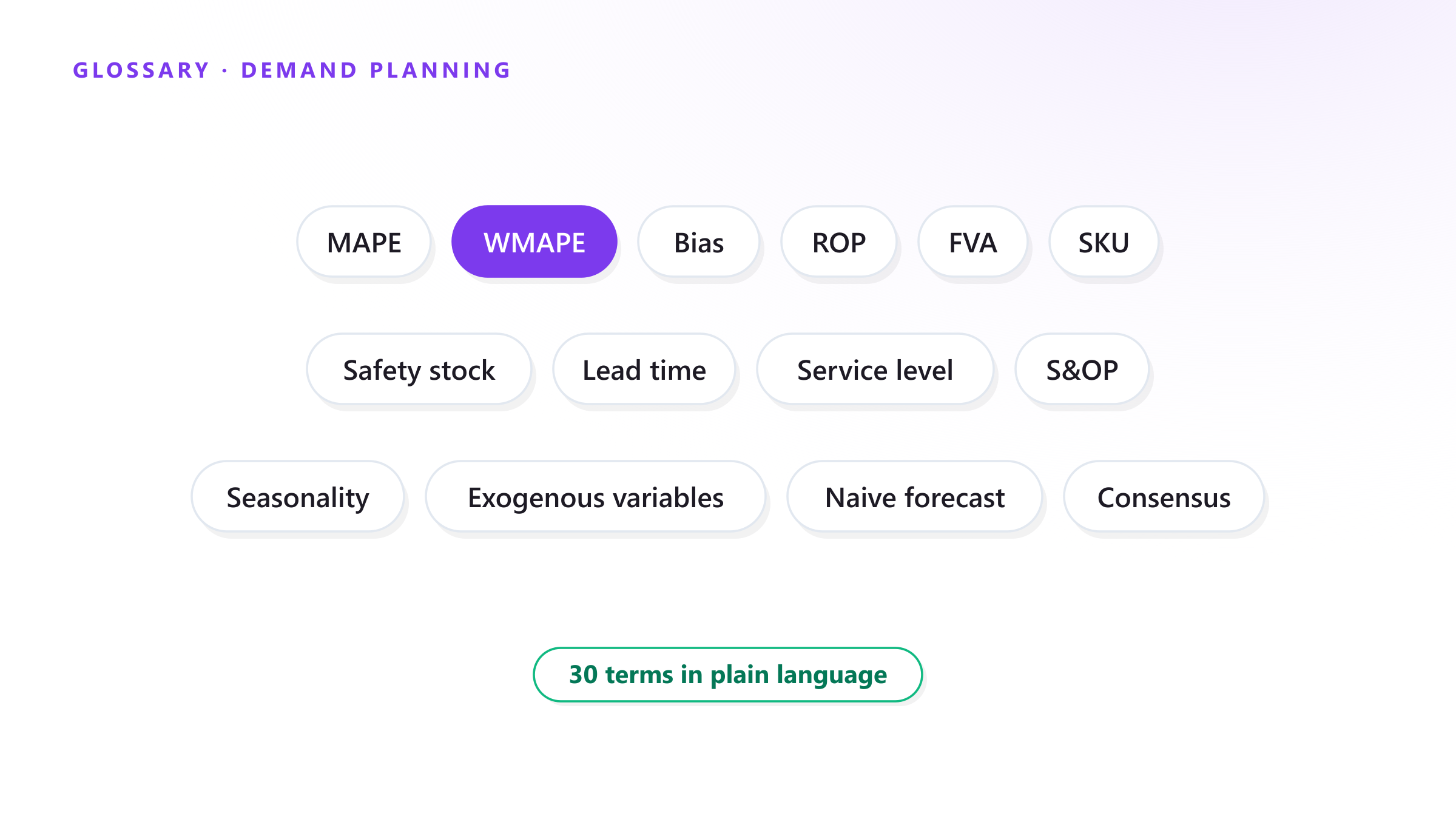
Every discipline has its dialect, and demand planning’s is dense: WMAPE, ROP, S&OP, FVA. This glossary defines the 30 terms you’ll actually meet in meetings — in plain language, with links to our deeper guides where a definition deserves a full article. Definitions follow standard usage (ASCM’s supply chain body of knowledge and Hyndman & Athanasopoulos’s Forecasting: Principles and Practice are the canonical references).
Forecasting fundamentals
- Demand planning — the process of estimating future sales to drive inventory, purchasing, production and budget decisions. The full picture is in our demand planning guide.
- Forecast — a data-based estimate of future demand for a given item, place and period. Not a goal, not a budget: an estimate.
- Baseline forecast — the statistical/ML forecast before anyone touches it. The reference point for measuring whether human adjustments help.
- Forecast horizon — how far ahead you forecast (next week, 3 months, 18 months). Accuracy decays as the horizon grows.
- Granularity — the level of detail: SKU × store × day is fine-grained; category × country × year is coarse. Forecast at the level you act on.
- Time series — a sequence of values over time (e.g., weekly sales of one SKU). The raw material of forecasting.
- Seasonality — a repeating, calendar-linked pattern: December peaks, summer slumps, payday weeks.
- Trend — the sustained direction of demand (growing, flat, declining) underneath the seasonal noise.
- Exogenous variable — an external demand driver fed into the model: weather, prices, promotions, holidays. The signals that won the M5 competition.
- Demand sensing — using very recent signals (today’s sell-through, weather) to adjust the short-term forecast.
- Promotional uplift — the extra demand a promotion generates. Part of it is real growth; part is displaced demand borrowed from the weeks around it.
Accuracy and error
- Forecast error — the gap between forecast and actual. The thing to measure, not to hide. Full treatment in accuracy metrics that matter.
- MAPE (Mean Absolute Percentage Error) — average percentage error, every item weighted equally. Easy to read, easily distorted by the long tail.
- WMAPE / WAPE — MAPE weighted by volume, so error on your top sellers counts proportionally. The retail standard.
- Bias — systematic error in one direction. An always-optimistic forecast quietly piles up inventory month after month.
- Naive forecast — “next period = last period.” Costs nothing; the benchmark every method must beat.
- FVA (Forecast Value Added) — measuring whether each step in your process (model, planner overrides, consensus) improves accuracy versus the previous step.
- Holdout / backtesting — evaluating a method on history it didn’t see: train on the past, test on the recent months.
- Confidence interval — the range around a forecast within which actuals are expected to fall with a stated probability.
Inventory
- SKU (Stock Keeping Unit) — the finest sellable unit you track: one product, one variant.
- Safety stock — buffer inventory that absorbs demand spikes and supply delays. Formulas and a worked example in our safety stock guide.
- Reorder point (ROP) — the inventory level that triggers a purchase order: demand during lead time + safety stock. Worked example here.
- Lead time — the time from placing an order to having it sellable. Its variability matters as much as its average.
- Service level — the probability of not stocking out in a cycle (e.g., 95%). Higher service costs exponentially more buffer.
- Stockout — demand arrives, shelf is empty. Costs ~4% of retail sales per Corsten & Gruen.
- Overstock / excess inventory — stock beyond what demand justifies: frozen cash, markdowns, write-offs.
- Inventory turnover — how many times a year you sell through your average inventory. Low turns = capital sleeping in the warehouse.
- ABC/XYZ analysis — segmenting the catalog by value (ABC) and demand variability (XYZ) to allocate planning effort. The 3×3 matrix is here.
Process and organization
- S&OP (Sales & Operations Planning) — the monthly cycle that aligns commercial, supply and finance around one demand plan. Plain-terms guide here.
- Consensus forecast — the agreed number that emerges from the demand review, combining the baseline with market intelligence.
- One number — shorthand for “one agreed demand plan.” Rightly understood, one plan with different views — not one literal figure for everyone.
Two terms missing? Probably Machine Learning and global model: an ML forecasting engine learns patterns across your entire catalog at once — which is how Forecast Studio forecasts thousands of SKUs nightly, with exogenous variables, at up to 95% accuracy. The fastest way to make this vocabulary concrete is to see it running on your own data: book a free demo.
Sources: ASCM insights — supply chain body of knowledge · Hyndman & Athanasopoulos, Forecasting: Principles and Practice · Makridakis et al., M5 accuracy competition, IJF · Corsten & Gruen, Stock-Outs Cause Walkouts, HBR · Gilliland, Forecast Value Added Analysis, SAS